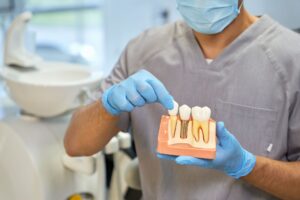
Dental implants are one of the most reliable, natural-looking ways to replace missing teeth — but they aren’t the right solution for everyone. If you’ve been told you may not be a good candidate, or you’re worried you won’t qualify, this guide explains the most common issues, why they matter, and what alternatives still give you a strong, confident smile.
Before we begin, remember: many patients who think they’re “not candidates” actually are — especially with modern techniques like bone grafting, All-On-X, and digitally guided surgery.
If you’re unsure, a consultation at any of our Southern California implant centers can give you clear answers.
1. You Have Severe Bone Loss in the Jaw
Dental implants need enough healthy bone to “lock in” securely. When a tooth has been missing for months or years, the jawbone shrinks — sometimes significantly.
Why it matters
The implant post acts like a tooth root. Without adequate bone depth and width, the post may not integrate correctly.
Signs of inadequate bone:
- Sunken appearance in the cheeks or jaw
- Denture looseness
- A very narrow ridge under missing teeth
What to do instead
The good news? Bone loss no longer automatically disqualifies you. Options include:
- Bone grafting
- Sinus lifts (for upper molars and premolars)
- All-On-X full mouth implants, which use strategic angles to avoid weak bone areas
- Zygomatic implants (for extreme cases)
Patients with bone loss often begin their research on our full-mouth implant education page, so linking naturally within the article, we would include:
A modern approach like All-On-X full mouth dental implants allows many bone-loss patients to avoid major grafting.
2. You Have Active Gum Disease
Gum disease (periodontitis) is one of the leading causes of implant failure.
Why it matters
Inflammation around the gums can prevent proper healing and can even lead to the implant loosening later.
What to do instead
Treat gum disease before implants. Many patients only need:
- Deep cleaning (scaling and root planing)
- Antibiotic therapy
- Laser periodontal treatment
Once gums are healthy, implants become a safe option again.
3. You Smoke Heavily or Vape Daily
Nicotine restricts blood flow, slowing down healing — which is critical for implant success.
Why it matters
Smokers have a 2–3x higher risk of implant failure.
What to do instead
You don’t have to quit forever — but we recommend stopping at least 1–2 weeks before surgery and 2–3 months after.
Heavy smokers who cannot pause nicotine use may consider:
- Snap-on overdentures
- Fixed bridges
- Traditional partial dentures
Your implant specialist can assess risk based on your lifestyle.
4. You Have Uncontrolled Medical Conditions
Some health issues don’t disqualify you — only uncontrolled versions do.
Conditions that require extra caution include:
- Uncontrolled diabetes
- Autoimmune disorders
- Patients on high-dose steroids
- Recent cancer radiation in the jaw area
Why it matters
These conditions weaken your ability to heal and may interfere with osseointegration (the implant bonding to bone).
What to do instead
Most patients become eligible again once the condition is stable. Your specialist may also collaborate with your medical doctor to ensure implants are safe.
5. You Grind Your Teeth Severely (Bruxism)
Nighttime grinding puts tremendous pressure on teeth — sometimes over 1,000 pounds of force.
Why it matters
Chronic grinding can:
- Crack implant crowns
- Loosen implant screws
- Wear down restorations prematurely
What to do instead
Your implant dentist may recommend:
- A custom nightguard
- Bite adjustments
- A stronger implant restoration material (zirconia instead of porcelain)
Grinding rarely disqualifies someone permanently — it just needs to be managed.
What If You’re Not a Candidate Right Now?
Many patients can become candidates once underlying issues are addressed. Your options include:
✔ Bone grafting or sinus lifts
To rebuild jawbone structure.
✔ All-On-4 / All-On-X implants
Designed specifically for people with low bone density.
✔ Implant-supported bridges
Require fewer implants for multiple missing teeth.
✔ Removable partial or full dentures
Good for patients needing an affordable non-surgical solution.
✔ Snap-on dentures
Use 2–4 implants for stability without full reconstruction.
How to Know for Sure If You’re a Candidate
The only way to get a clear answer is through a 3D CT scan and evaluation. At California Dental Implants Specialists, every location offers in-office digital CT imaging so we can measure bone levels, nerve position, and implant feasibility with precision.
You can also learn more about the full implant process on our educational pages, such as the implant FAQ, the implant process, and the general “why dental implants” page — all automatically linked based on your sitemap when published.
Schedule a Free Consultation at Any of Our Southern California Offices
Each center is fully equipped with advanced imaging, experienced implant specialists, and flexible financing.
Huntington Beach Implant Center
California Dental Implants Specialists – Huntington Beach
18800 Main St #110A
Huntington Beach, CA 92648
Phone: 714-418-4480
Pacifica Location
California Dental Implants Specialists – Pacifica
18800 Main St #110C
Huntington Beach, CA 92648
Phone: 714-418-4480
Marina del Rey Implant Center
California Dental Implants Specialists – Marina
4292 Lincoln Blvd
Marina del Rey, CA 90292
Phone: 310-905-8747
Downey Implant Center
California Dental Implants Specialists – Downey
8512 Paramount Blvd
Downey, CA 90240
Phone: 562-662-3773
Final Takeaway
Many people who believe they’re “not candidates” actually are — they simply need the right treatment plan and a specialist experienced in advanced implant solutions. Whether you have bone loss, gum issues, or medical concerns, today’s dental technology offers more solutions than ever.