Sticker shock stops a lot of people before they even book the consult. If you have been wondering how to afford dental implants, the good news is that the full price you see online is rarely the only path forward. Between insurance benefits, financing, phased treatment plans, promotions, and choosing the right type of implant solution, many patients find implants are more realistic than they first assumed.
That matters because waiting has a cost too. Missing teeth can make it harder to chew, affect speech, change facial support, and put more stress on the teeth you still have. A temporary fix may look cheaper at first, but if it needs frequent adjustments or replacement, the long-term value can shift quickly.
How to afford dental implants without guessing
The fastest way to make implants feel out of reach is to compare random prices without knowing what is included. One office may advertise a low number for the implant post alone, while another may quote a more complete fee that includes imaging, the abutment, and the final crown. Before you assume treatment is too expensive, ask for a clear breakdown.
A real estimate should explain whether your price includes the consultation, 3D CT imaging, extraction if needed, bone grafting if needed, the implant itself, and the final restoration. Some patients need only a straightforward single implant. Others need preparatory treatment because of bone loss or gum issues. That is why the first step is not hunting for the cheapest number. It is understanding your actual clinical situation.
In many cases, affordability improves once treatment is personalized. You may not need the most extensive option. Or you may learn that a more comprehensive plan gives you better long-term value than repeating short-term fixes.
Start with the consultation, not the assumption
Many patients delay because they expect the answer will be no. They assume implants are only for people with perfect insurance or a large savings account. In reality, a consultation often opens up options that are hard to see from the outside.
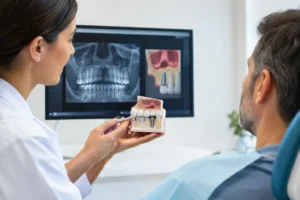
A proper implant consultation should review your oral health, explain whether you are a candidate, and map out what must be done now versus what can wait. This is where affordability gets practical. If a provider offers free consultations or in-house imaging, that can lower the barrier to getting real answers.
It is also the point where you can ask the questions that matter: Can treatment be phased? Are there promotional offers? Do you accept my insurance? Do you provide financing? Can I choose between a single implant, implant bridge, or implant-supported denture depending on budget and goals?
When the process is transparent, patients can make decisions with confidence instead of fear.
The biggest factors that affect cost
Dental implants are not one-size-fits-all, so the final cost depends on several details. The number of missing teeth matters, of course, but so does the condition of your jawbone and gums. If a tooth has been missing for a long time, bone shrinkage may require grafting before implant placement. That adds time and cost, but it can also protect the long-term success of the implant.
The type of restoration also changes the math. Replacing one tooth with one implant is different from restoring a full arch. For patients missing several teeth, an implant bridge may be more efficient than placing an implant for every missing tooth. For full-mouth cases, All-On-4 or All-On-X can sometimes provide a more streamlined solution than replacing teeth one by one.
Material choices, sedation needs, and the experience level of the treating team also play a role. Lower pricing is attractive, but it should be weighed against diagnostics, technology, and the precision of the treatment plan. Implants are meant to last. A low upfront number does not always mean lower cost over time.
Insurance can help, even when it does not cover everything
One reason patients assume implants are unaffordable is that dental insurance coverage can be inconsistent. Some plans cover part of the procedure, some cover related steps such as extractions or crowns, and some offer little implant-specific support. But partial coverage is still meaningful.
Even if your plan does not pay for the implant post itself, it may contribute to diagnostics, preliminary treatment, or the final restoration. That can reduce your out-of-pocket total more than you expect. Medical insurance may also become relevant in select cases tied to trauma or medically necessary reconstruction, though that depends heavily on the individual plan.
The key is verification. A provider who accepts insurance and helps review your benefits can often identify savings patients would miss on their own. Good treatment coordinators know how to present costs clearly and help you understand what insurance can realistically contribute.
Financing often makes implants manageable
For many working adults and retirees, the real question is not whether they can pay the full amount at once. It is whether they can fit treatment into a monthly budget. That is where financing changes the conversation.
Monthly payment options can make a high-value treatment feel far more accessible. Instead of postponing care for years, patients may be able to move forward with a payment structure that works alongside regular household expenses. This can be especially helpful for full-mouth restoration, where the health and quality-of-life benefits are significant, but the upfront number may feel intimidating.
Still, financing is not automatically the right fit for everyone. Interest rates, approval terms, and monthly payment amounts vary. It is smart to compare the total repayment cost, not just the monthly number. Affordability should feel sustainable, not stressful.
Promotions can lower the entry point
Promotional pricing can make implant treatment easier to begin, especially for patients who have been putting off care. If a practice offers a clearly stated implant promotion, that may reduce the initial financial hurdle and help patients act before a missing tooth leads to more bone loss or shifting teeth.
The important part is clarity. Ask exactly what the promotion includes and what additional procedures might still be necessary. A strong offer is helpful, but it should sit inside a complete treatment plan, not replace one.
For patients in Southern California comparing providers, affordability and specialist-level care do not have to be opposites. California Dental Implants Specialists is built around that balance, with consultation-driven planning, financing options, insurance acceptance, and pricing designed to make advanced implant care more attainable.
Choosing the right treatment can save money long term
A cheaper option is not always the most affordable option. Traditional dentures, flippers, and repeated patchwork dental work may cost less at the start, but they can come with ongoing adjustments, replacements, discomfort, and limits on eating and speaking.
Implants often deliver more stability, more natural function, and longer-lasting support for the jaw. That long-term value matters. For someone tired of dealing with a loose denture or a failing bridge, paying strategically for a more permanent solution can be the better financial decision over time.
That said, it depends on your needs. Some patients truly do better with phased care. Others need a full-mouth solution now because delaying treatment would only increase complexity. The right provider will not push one answer for everyone. They will help you weigh immediate budget, long-term durability, and your daily quality of life.
Practical ways to make dental implants affordable
If you are serious about moving forward, a few choices can make the path smoother. Start by getting a detailed consultation and written estimate. Review your insurance benefits before ruling them out. Ask whether treatment can be broken into stages if that helps financially. Explore monthly financing, but look at the total cost as well as the payment amount.
Also ask whether there are alternatives that still meet your goals. If you are replacing multiple teeth, an implant bridge or implant-supported denture may be more cost-effective than several individual implants. If timing matters, acting sooner may reduce the chance that bone loss creates additional expense later.
Most of all, avoid making the decision based on a headline price alone. The best value usually comes from a plan that is precise, transparent, and built to last.
If the cost of implants has made you hesitate, that hesitation is understandable. But affordability is often less about finding a miracle discount and more about finding a team that can show you a realistic path forward with clarity, options, and care that feels worth investing in.