
Patient education
Temporary Teeth While Your Implant Heals: Your Options
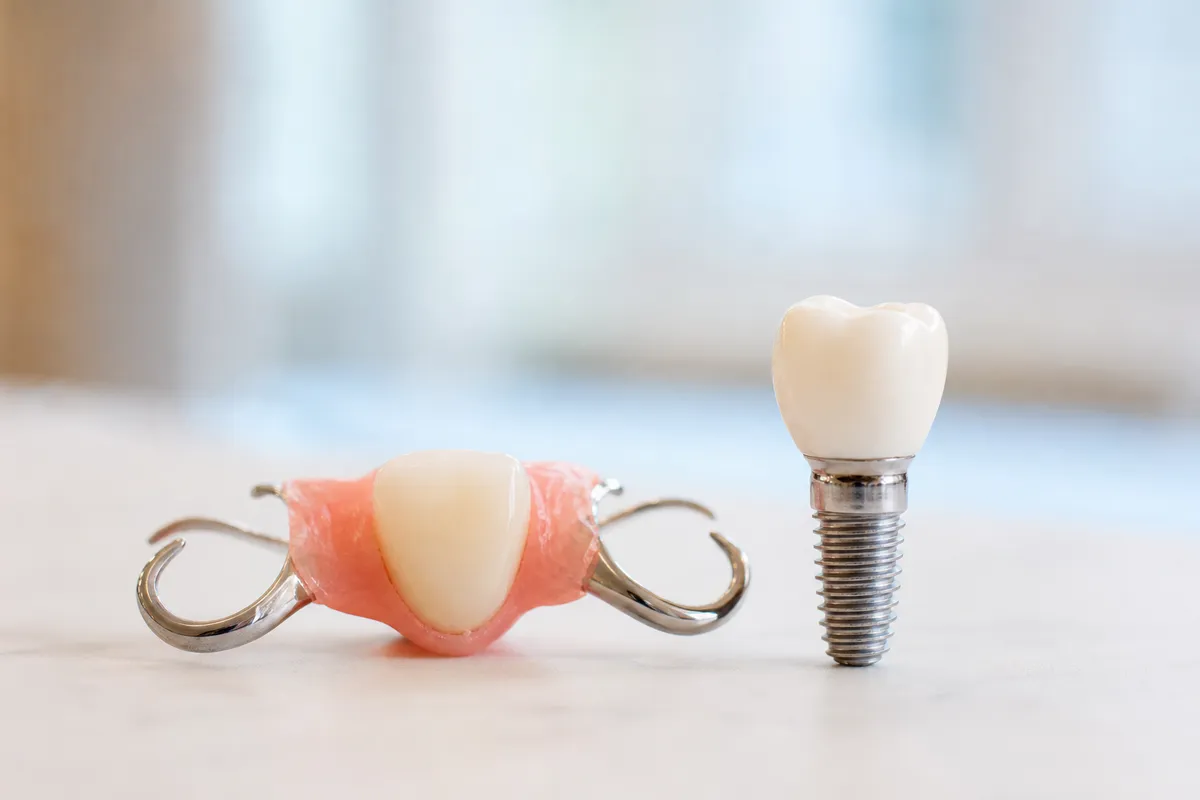
While a dental implant heals and bonds with the bone, there are several ways to fill the gap: a removable temporary tooth (often called a flipper), a clear retainer with a tooth in it, a temporary bridge bonded to the neighboring teeth, or sometimes a temporary crown attached to the implant itself. Front teeth almost always get a temporary; for back teeth, many people choose to leave the gap until the final crown. The right option depends on where the tooth is, how stable the implant is, and how your bite works.
Why there's a waiting period at all
After placement, an implant needs time to bond with the bone before it takes full chewing force. That healing period is what the temporary covers. Our implant process page walks through each stage.
The temporary options
- Removable partial (flipper): a small acrylic plate with a tooth that clips in. Quick and simple; it comes out for eating and cleaning.
- Clear retainer with a tooth: a thin, clear tray over your teeth with a tooth in the gap. Discreet for front teeth; not for chewing.
- Temporary bridge: a tooth bonded to the teeth on either side. It stays in, but it relies on the neighboring teeth.
- Temporary crown on the implant: a tooth attached to the implant itself, used only when the implant is stable enough at placement, and kept out of heavy biting.
What a temporary must never do
A temporary shouldn't press on the healing implant or the gum over it. Pressure during healing can disturb the bond between implant and bone. If a temporary starts to rub, rock, or press, call your office rather than living with it.
Can I eat with a temporary?
Carefully. Most temporaries are for appearance and short-term comfort, not normal chewing. Removable ones usually come out for meals, and fixed ones need soft foods on that side. Your team will tell you what yours can handle.
Full-arch temporaries
When a whole arch is replaced, many plans include a temporary bridge attached to the new implants while they heal, followed by the final bridge. Ask whether yours does; our All-On-X page explains the full-arch sequence.
Is the temporary a separate cost?
Often it's its own line in the written estimate, so ask whether it's included and which type. Our $699 dental implant offer covers the titanium implant post, the implant consultation exam, and X-rays; the CT scan, abutment, crown, and sedation are priced separately and quoted in writing before any treatment begins.
Monthly payment plans are available through third-party partners such as Cherry, Sunbit, and CareCredit, subject to credit approval.
A consultation with an exam and imaging gives you a written, itemized plan.
Related questions
Will I have a gap while my implant heals?
Usually not for a front tooth. A removable temporary, a clear retainer with a tooth in it, a temporary bridge, or sometimes a temporary crown on the implant can fill the space. For back teeth, many people choose to leave the gap while the implant heals.
Can I chew on a temporary tooth?
Usually not normally. Temporaries are for appearance and short-term comfort, and biting hard on one can disturb a healing implant. Your team will tell you what your temporary can handle.
Is a temporary tooth included in the cost of an implant?
It depends on the plan. A temporary is often a separate line in a written estimate, so ask whether it's included and what type it is.