
Patient education
Zygomatic Implants: Options When the Upper Jaw Has Very Little Bone
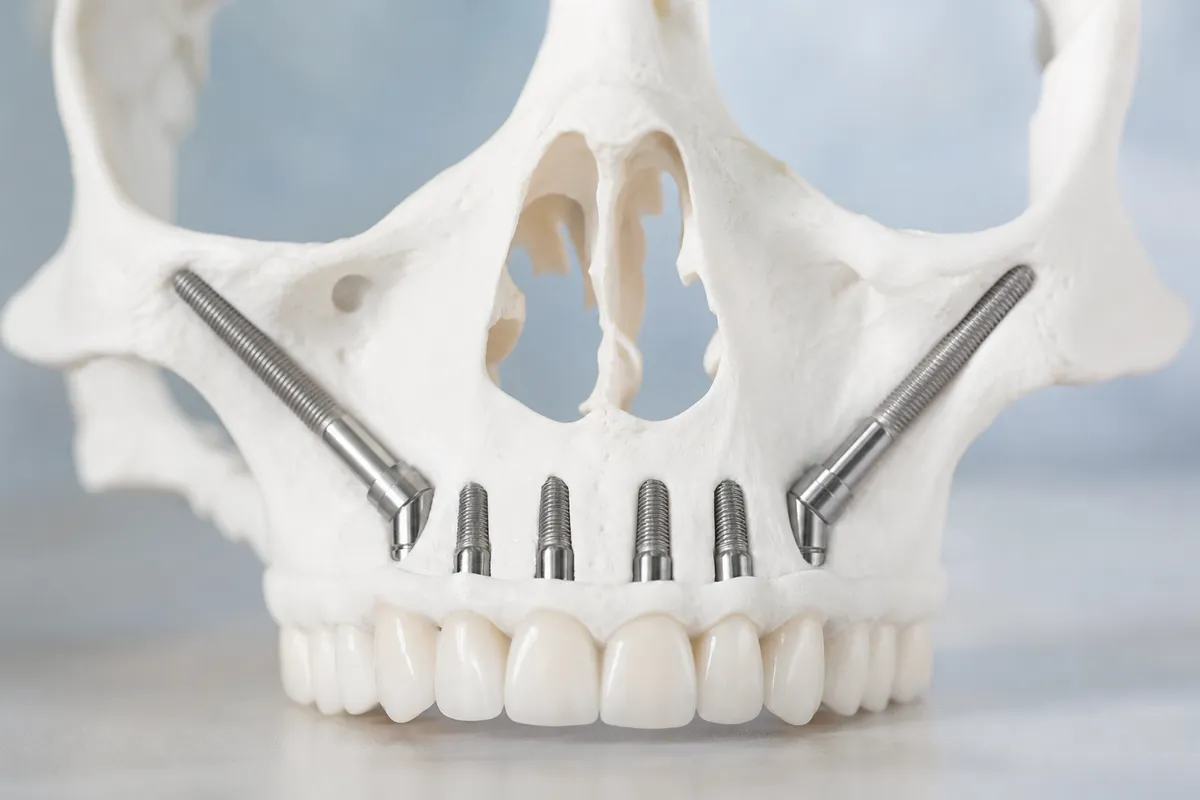
Zygomatic implants are long dental implants anchored in the cheekbone (the zygoma) instead of the upper jawbone. They are used to support upper teeth when the upper jaw has too little bone for standard implants, often after years without teeth or with dentures. Their main appeal is that they can avoid extensive bone grafting. They are a specialized procedure, not offered by every practice, and whether they're an option depends on CT imaging of your jaw and cheekbones.
Why the upper jaw runs out of bone
After teeth are lost, the jawbone that held them gradually shrinks, and in the upper jaw the sinus can expand into the space. Years later there may be too little bone height or width for standard implants. Our article on what happens if you don't replace a missing tooth explains the process.
How zygomatic implants work
A zygomatic implant is much longer than a standard implant. It enters near the back of the upper jaw and angles up to anchor in the dense bone of the cheekbone. Zygomatic implants are usually combined with standard implants in the front of the jaw to support a fixed full-arch bridge.
The alternatives
- Bone grafting and sinus lifts to rebuild the upper jaw, then standard implants.
- Angled implants (as in All-On-4 designs) that reach the bone that remains.
- An implant-supported or traditional upper denture, which relies less on bone height.
See sinus lift surgery, bone loss and implants, and upper vs. lower jaw implants.
Who might be a candidate
People with severe upper bone loss who want fixed teeth and for whom grafting would be extensive or has already failed. General health matters too, as with any implant surgery. The decision is made from CT imaging and a full exam.
Questions to ask
- Is my upper bone loss severe enough that standard implants won't work, even with grafting?
- Do you place zygomatic implants yourself, or refer to a surgeon who does?
- What are the risks and recovery compared with grafting and standard implants?
- What would the final teeth be, and how are they maintained?
Our $699 dental implant offer covers the titanium implant post, the implant consultation exam, and X-rays; the CT scan, abutment, crown, and sedation are priced separately and quoted in writing before any treatment begins.
If you've been told you don't have enough bone, a consultation with an exam and imaging gives you a written, itemized plan.
Related questions
What is a zygomatic implant?
A long dental implant anchored in the cheekbone (zygoma) instead of the upper jawbone. It is used to support upper teeth when the upper jaw has too little bone for standard implants.
Who might need zygomatic implants?
People with severe bone loss in the upper jaw, often after years without teeth or with dentures, for whom standard implants would require extensive bone grafting. CT imaging decides whether they're an option.
Do all dental offices place zygomatic implants?
No. It is a specialized procedure. Ask whether a practice places zygomatic implants itself or refers patients to a surgeon who does, and what the alternatives are for your case.